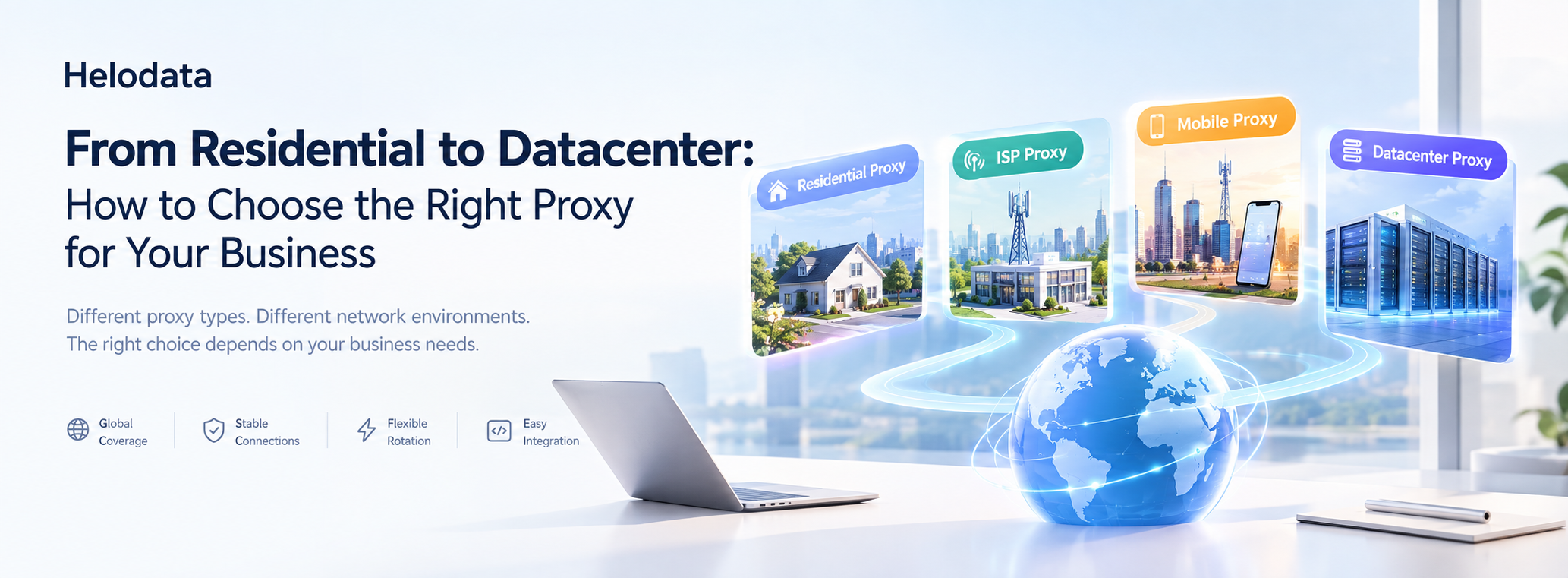
From Residential to Datacenter: How to Choose the Right Proxy for Your Business
Residential, datacenter, ISP, and mobile proxies serve different business needs. Learn how to choose the right proxy based on network type, location, IP rotation, stability, and real-world performance.

As global business, web data collection, SEO monitoring, and cross-border e-commerce continue to grow, proxy IPs have become an important part of many companies’ and developers’ online workflows.
But proxies are not all the same.
Residential, datacenter, ISP, and mobile proxies each come with different network characteristics, stability, rotation options, and use cases.
That means choosing a proxy should not simply come down to the number of IPs or the lowest price. The more important question is: What kind of network environment does your business actually need?
In this guide, we’ll break down the main proxy types, explain where each one fits, and show how to choose a proxy based on your actual business requirements.
Why Does Proxy Type Matter?
When you access a website directly, the destination server can generally see the IP address associated with your connection.
With a proxy, your request is routed through a proxy server before reaching the target website. This can provide businesses and developers with different network exit points, locations, and IP configurations.
However, the network behind each proxy can be very different.
Datacenter proxies typically come from data centers or cloud networks, while residential proxies are associated with residential internet connections. Mobile proxies use IP resources connected to mobile networks.
These differences can affect how a proxy performs in a particular workflow.
That is why understanding the proxy type should be the first step when selecting a proxy solution.
Residential Proxies: For Residential Network Environments
Residential proxies generally use IP addresses associated with residential internet networks.
Compared with traditional datacenter IPs, residential proxies provide a network environment that is closer to everyday home internet connections, making them useful for projects that require residential IP resources.
Common use cases include:
- Global market research
- Web data collection
- SEO monitoring
- Cross-border e-commerce research
- Price and inventory monitoring
- Localized content testing
- Public web data collection
Location is also an important factor.
For example, a company researching the US market may need US residential IPs, while a project focused on Japan may require Japanese IPs.
For these use cases, the location of an IP can be just as important as the size of the IP pool.
Dynamic Residential Proxies
Dynamic residential proxies allow IPs to rotate according to the requirements of a project.
This can be useful for workflows that involve frequent web requests or require access from multiple locations.
For example, a price monitoring project may need to access a large number of product pages on a regular basis. A flexible IP rotation setup can help support this type of workflow.
However, more frequent rotation is not always better. Rotation settings should be determined by the target website, request volume, and the requirements of the project.
Datacenter Proxies: Speed and Scalable Access
Datacenter proxies generally come from data centers, cloud providers, or server networks.
Because datacenter networks are built around dedicated infrastructure, they are often suitable for workflows where speed, scalability, and cost are important considerations.
Common use cases include:
- SEO tools
- Automated testing
- Website monitoring
- Large-scale public data access
- API-related workflows
- High-volume web requests
For projects that do not require a residential network environment but need efficient connections and scalable access, datacenter proxies can be a practical option.
For example, a company monitoring a large number of public web pages may use datacenter proxies when the target websites allow this type of traffic.
However, websites have different access policies and security systems. Some may apply stricter controls to traffic coming from data center networks.
For this reason, testing a proxy on a smaller scale before deploying it across a larger workflow is recommended.
ISP Proxies: Stable Connections and Specific Network Attributes
ISP proxies are generally associated with IP addresses registered through Internet Service Providers.
They are sometimes marketed as “static residential proxies,” although terminology can vary between providers.
Instead of relying solely on the product name, it is better to look at the actual IP registration information, network characteristics, and connection behavior.
ISP proxies can be useful for workflows that require a relatively stable network exit, such as:
- Long-term web access
- Location-based testing
- Ad verification
- Long-running automated workflows
- Tasks that benefit from IP consistency
If a project needs to maintain a relatively consistent network environment over time, stability may be more important than having access to a very large number of IPs.
Mobile Proxies: When You Need a Mobile Network Environment
Mobile proxies use IP resources associated with mobile networks, giving them different network characteristics from residential and datacenter proxies.
For businesses that need to test or access services through mobile network environments, mobile proxies can provide a more suitable network option.
Typical use cases include:
- Mobile business testing
- Mobile advertising verification
- Localized content testing
- Mobile app-related research
- Automated workflows that require mobile network access
Mobile proxies are not necessarily the right solution for every project.
For large-scale web access, factors such as cost, connection efficiency, and IP availability may be more important. For projects that specifically require mobile network characteristics, however, mobile proxies can be a better fit.
How Should You Choose a Proxy for Different Business Needs?
Understanding the different proxy types is only the first step.
The more important question is:
Which proxy type fits your actual workflow?
Let's look at several common use cases.
1. Web Data Collection
Data collection projects often involve accessing a large number of web pages.
Before choosing a proxy, consider:
- Target website policies
- Request volume
- IP rotation requirements
- Target locations
- Connection stability
If the target website places relatively few restrictions on datacenter traffic, datacenter proxies may be suitable.
If the project requires more diverse network environments or residential locations, residential proxies can be tested instead.
For large-scale projects that continuously collect public web data, dynamic residential proxies can also provide a flexible IP rotation option.
2. SEO Monitoring
SEO monitoring often requires checking search results across different countries and regions.
The same keyword may return different results depending on the user's location and network environment.
For businesses conducting international SEO research, accessing search engines and websites through the appropriate regional IP can therefore be important.
Key factors include:
Location coverage + IP stability + access success rate
For small-scale keyword testing, a relatively stable proxy may be enough.
For long-term monitoring across a large number of keywords, a more flexible proxy rotation setup may be appropriate.
3. Cross-Border E-Commerce
E-commerce companies often need to research:
- Product prices
- Inventory
- Product pages
- Promotions
- Search results
- Competitor information
Some of this information can vary depending on the user's location.
Proxies can help businesses access public information from the network environment of a target market.
For example:
US market → US proxy IPs
Japan market → Japan proxy IPs
Germany market → Germany proxy IPs
When monitoring multiple markets, businesses can select residential proxy resources based on their target countries and project requirements.
4. Market Research
Market research often involves more than checking a single website.
A company may need to research multiple countries, platforms, and large volumes of public information.
In these cases, geographic coverage and IP diversity can become important factors.
Residential proxies can be used for projects that require access from different regional network environments, while datacenter proxies may be suitable for tasks that prioritize speed and scalability.
The right choice should ultimately be determined by the target websites and actual testing results.
5. Automation and AI Workflows
AI agents, browser automation, and other automated tools are increasingly being integrated into business workflows.
Some automated tasks may need to access websites from different regions, collect public information, or perform website testing.
A proxy can serve as the network exit for these automated workflows, allowing different tasks to use IP resources that match their requirements.
For automation projects, it is important to consider more than the proxy type:
- Proxy configuration
- IP rotation
- Session persistence
- Geographic targeting
- Connection stability
Instead of comparing proxy providers only by IP pool size, businesses should test how the proxy performs within their actual workflow.
How Helodata Supports Different Proxy Needs
Businesses and developers rarely have identical proxy requirements.
Some projects need residential IPs, while others require dynamic rotation, mobile network environments, or specific geographic locations.
Helodata provides proxy solutions for businesses and developers, allowing users to select proxy resources based on their project requirements.
Pure Residential IPs
Helodata provides residential IP resources for use cases such as market research, web data collection, SEO monitoring, cross-border e-commerce, and other workflows that require a residential network environment.
For projects that involve continuous web access, dynamic residential proxies can provide a flexible solution based on the project's requirements.
Dynamic Residential Proxies
Helodata's dynamic residential proxies start at $0.85/GB.
They can be used for projects that require IP rotation, geographic targeting, or continuous public web access.
Mobile Proxies
For projects that require a mobile network environment, Helodata also provides mobile proxy resources starting at $1.60/GB.
Businesses can select the appropriate option based on their target market, network requirements, and workflow.
Don't Choose a Proxy Based Only on IP Pool Size
IP pool size is one of the first things many users look at when comparing proxy providers.
But it is only one part of the overall picture.
A more complete proxy evaluation should consider the following:
Proxy Type
Determine whether the project requires residential, datacenter, ISP, or mobile network resources.
Geographic Coverage
If your business operates across multiple markets, check whether the proxy service covers the countries and regions you need.
IP Rotation
For workflows involving frequent requests, make sure the rotation method matches the requirements of your project.
Stability
Frequent connection failures can interrupt data collection and automated workflows, making connection stability an important consideration.
Real-World Performance
Different websites use different security and traffic-management systems.
Two proxy services using the same general proxy type can still perform differently in real-world conditions.
Testing a small number of IPs before scaling up can therefore provide a more realistic understanding of performance.
A Practical Framework for Proxy Selection
The proxy selection process can be simplified into five steps:
Step 1: Define your business goal
Are you collecting data, monitoring SEO, researching e-commerce markets, or running automated workflows?
Step 2: Identify your target locations
Which countries or regions do you need to access?
Step 3: Choose the network type
Do you need residential, datacenter, ISP, or mobile IPs?
Step 4: Determine how you will use the IP
Do you need a relatively stable IP, or does your workflow require rotation?
Step 5: Test before scaling
Evaluate connection speed, stability, access success rates, and actual performance within your workflow.
Following these steps can make it easier to identify a proxy solution that matches your project's requirements.
Conclusion
Different proxy types are designed around different network environments and business requirements.
Residential proxies are useful for projects that require residential network environments and geographic access.
Datacenter proxies can be suitable for workflows that prioritize speed, scale, and cost efficiency.
ISP proxies can support use cases that require relatively stable connections and specific network attributes.
Mobile proxies are designed for workflows that require mobile network environments.
Rather than asking which proxy type is universally “best,” businesses should first identify what their project actually requires.
Consider the network type, target location, IP rotation, stability, and real-world performance before making a decision.
For businesses and developers looking for global proxy resources, Helodata provides residential, dynamic residential, and mobile proxy options that can be selected according to different project requirements.
Helodata — Proxy Solutions for Global Business & Data Workflows.