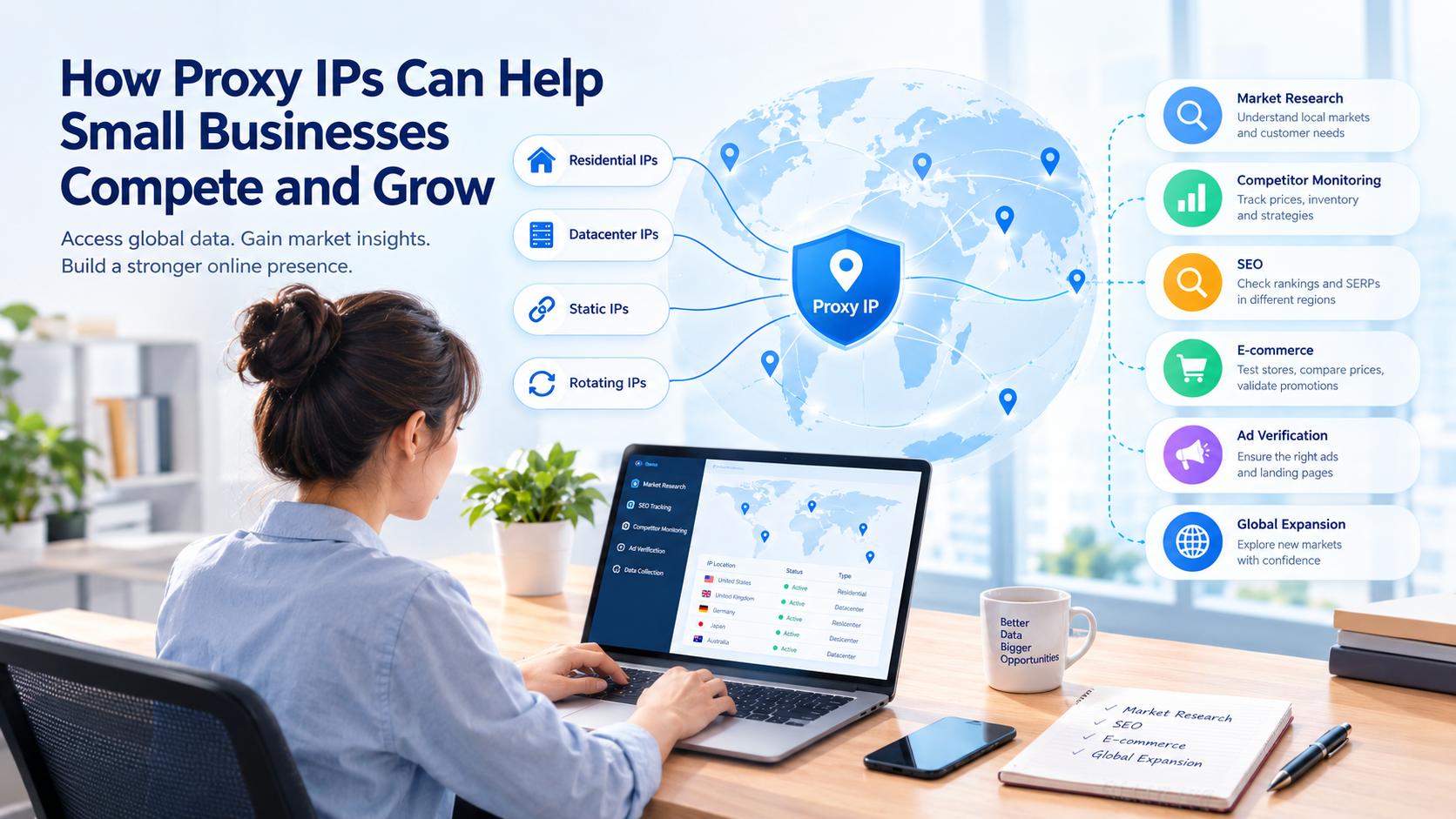
How Proxy IPs Can Help Small Businesses Compete and Grow
Proxy IP services can help small businesses access localized information, collect market data, monitor competitors, verify advertisements, and support cross-border operations. By choosing the right proxy type and using it responsibly, businesses can gain valuable market insights and improve operational flexibility without building complex network infrastructure.

Introduction
For small businesses, competing in a digital-first market often means doing more with fewer resources. Large enterprises may have dedicated data teams, substantial research budgets, and sophisticated technology infrastructure. Smaller companies, on the other hand, frequently need to make important decisions with limited time, staff, and information.
Whether a business is researching a new market, monitoring competitor prices, improving its search engine rankings, or expanding into another country, access to reliable online data can make a significant difference.
However, collecting and interpreting web data is not always straightforward. Websites may display different content depending on a visitor's location, restrict automated requests, apply rate limits, or identify repeated requests coming from the same IP address. These challenges can make it difficult for businesses to obtain consistent and geographically relevant information.
This is where proxy IP services can become useful.
A proxy service routes a user's or application's request through an intermediary IP address before it reaches the target website. Depending on the proxy type and configuration, businesses can access location-specific content, manage different connection sessions, and support a range of research, monitoring, and testing workflows.
For small businesses, the value of proxy IPs is not simply about changing an IP address. It is about gaining more flexible access to online information, improving the efficiency of digital operations, and supporting better business decisions.
Proxy IPs are not a universal solution for every access challenge. They do not guarantee that every request will succeed, eliminate all CAPTCHAs, or make an activity compliant with a website's rules. Their effectiveness depends on the proxy type, target website, request behavior, and overall implementation.
For this reason, small businesses should view proxy services as one component of a broader data and operations strategy.
What Are Proxy IPs and Why Do They Matter to Small Businesses?
A proxy IP is an IP address used by a proxy service to forward a user's or application's internet request. Instead of connecting directly to a target website through the user's original IP address, the request is routed through the proxy service.
Depending on the service and configuration, this can help businesses access online content from different geographic locations and organize their network requests for specific business purposes.
For small businesses, proxy IP services may provide several practical benefits:
- Location-specific access: View websites and online content from selected geographic locations.
- More flexible data collection: Use different IP addresses and session configurations for structured research workflows.
- Improved operational organization: Integrate proxy services with tools used for data collection, monitoring, automation, and testing.
- Greater network flexibility: Support workflows that require different IP locations or connection sessions.
It is important to understand that proxy IPs are not a universal solution for every access problem. A proxy service cannot guarantee that every request will succeed, eliminate all CAPTCHAs, or make an activity compliant with a website's rules. Its effectiveness depends on the proxy type, target website, request behavior, and overall implementation.
For small businesses, the best approach is to treat proxy services as one component of a broader data and operations strategy.
1. Conduct More Accurate Market Research
Market research is essential for understanding customer preferences, identifying demand, and evaluating new opportunities. Yet online information is often influenced by geography.
A customer in the United States may see different product prices, search results, promotions, or available services from a customer in Germany or Japan. If a business relies on data from only one location, it may develop an incomplete understanding of its target market.
Proxy IP services can help small businesses access localized web content and compare information across different regions.
Common Market Research Applications
A company entering a new market might use proxy IPs to:
- Review local product offerings and pricing.
- Compare regional promotions and shipping information.
- Analyze how competitors position their products.
- Examine market-specific search results.
- Identify differences in customer-facing content.
- Monitor changes in local demand indicators.
For example, a small online retailer planning to expand into several European markets may want to compare how similar products are presented in different countries. Accessing localized versions of relevant websites can help the retailer understand pricing structures, product availability, and promotional strategies before investing heavily in expansion.
The key benefit is not simply collecting more information. It is collecting more relevant information.
What Small Businesses Should Consider
Market research projects should begin with clearly defined questions. Businesses should determine which websites, locations, data fields, and collection frequencies are actually necessary.
Collecting excessive data without a clear objective can increase costs while making the results harder to interpret. A focused research plan is usually more useful than attempting to collect everything available online.
2. Monitor Competitor Prices and Product Availability
For e-commerce businesses, pricing and inventory can change quickly. A competitor may launch a promotion in the morning, adjust prices in the afternoon, or temporarily remove a product from sale.
Manually checking every competitor website is time-consuming, especially when a business tracks multiple products across different regions.
Proxy-enabled monitoring workflows can help businesses collect publicly available information more consistently.
How Competitor Monitoring Works
A typical monitoring workflow may include:
- Identifying competitor websites and relevant product pages.
- Defining the information that needs to be monitored.
- Selecting suitable geographic locations when content varies by region.
- Collecting publicly accessible product information at reasonable intervals.
- Comparing the results with internal pricing and inventory data.
- Using the findings to support pricing or purchasing decisions.
For example, a small consumer electronics retailer could monitor competitor prices for a selected group of products. If the business notices that several competitors have reduced their prices, it can evaluate whether to adjust its own pricing strategy, launch a promotion, or emphasize other product advantages.
Proxy IPs can support the access and collection side of this process, but the business still needs a reliable data-processing system. A proxy service alone does not turn raw web pages into useful business intelligence.
Why Consistency Matters
Competitor monitoring is most valuable when the data is collected under reasonably consistent conditions. If requests frequently fail, locations are inaccurate, or sessions behave unpredictably, the resulting data may be incomplete or misleading.
This is why businesses should evaluate proxy quality based on actual project requirements rather than focusing only on the number of available IP addresses.
3. Improve Local SEO and Search Visibility
Search engine optimization is a major growth channel for small businesses, particularly those that depend on local customers or operate across multiple regions.
However, search results are not always identical for every user. Location, language, device, search history, and other factors can influence what appears on a search engine results page (SERP).
A business that only checks rankings from its own office or home network may not see the same results as customers in other cities or countries.
Using Proxy IPs for Localized SEO Research
Proxy IP services can support SEO teams and marketing professionals when they need to:
- Review search results from different locations.
- Monitor keyword rankings in specific markets.
- Compare localized search result pages.
- Research competitors' visibility in target regions.
- Check whether location-specific landing pages are appearing as expected.
- Collect publicly available SERP data for analysis.
For instance, a company offering software services in both the United Kingdom and Australia may want to understand whether its target keywords perform differently in those markets.
Location-specific research can reveal differences in search competitors, featured results, and content opportunities.
This information can help the business make more informed decisions about:
- Which keywords to prioritize.
- Which markets need localized content.
- Whether separate landing pages are necessary.
- How competitors structure their SEO strategies.
- Where additional marketing resources should be allocated.
Proxy IPs Are Not an SEO Shortcut
Using a proxy does not automatically improve rankings. It simply helps businesses access and analyze search environments that may otherwise be difficult to observe accurately.
SEO results still depend on content quality, technical performance, relevance, authority, and many other factors. Proxy IPs are best viewed as a research and monitoring tool, not a replacement for a sound SEO strategy.
4. Support Cross-Border E-Commerce Operations
Cross-border e-commerce creates opportunities for small businesses to reach customers beyond their domestic markets. At the same time, international operations introduce new challenges.
A business may need to understand regional storefronts, verify localized product information, test customer journeys, or monitor how its website appears in different countries.
Proxy IP services can help businesses conduct these activities from relevant geographic locations.
Practical E-Commerce Use Cases
Small e-commerce teams may use proxy IPs to:
- Review regional versions of online stores.
- Compare product prices across markets.
- Check local shipping and delivery information.
- Monitor competitor inventory.
- Test localized landing pages.
- Validate region-specific promotions.
- Research marketplace listings.
- Observe how product information is displayed to users in different locations.
Consider a small fashion retailer preparing to enter a new country. Before launching a localized storefront, the retailer may need to confirm whether its product pages, currency display, shipping options, and promotional messages are appropriate for the target market.
Accessing the website through a relevant location can help the team identify inconsistencies that might not be visible from its primary market.
The Importance of Accurate Regional Data
Cross-border businesses should be careful not to assume that an IP location represents every aspect of a user's experience.
Websites may also use cookies, account settings, browser language, device information, and other signals to determine which content to display.
Therefore, proxy-based testing should be combined with other testing methods to obtain a more complete picture of the customer experience.
5. Verify Digital Advertisements and Marketing Campaigns
Advertising campaigns are often distributed across multiple regions, platforms, and audience segments. For small businesses, even a modest advertising budget needs to be used efficiently.
An advertisement may appear correctly in one market but display the wrong landing page, pricing, language, or promotional message in another. These issues can lead to wasted spending and a poor customer experience.
Proxy IP services can support ad verification, allowing businesses or their marketing partners to inspect how publicly accessible advertisements and landing pages appear from different locations.
What Ad Verification Can Help Identify
A business may use location-specific access to check:
- Whether an ad is appearing in the intended market.
- Whether the correct creative is being displayed.
- Whether the landing page matches the advertisement.
- Whether regional pricing or promotions are accurate.
- Whether tracking links redirect correctly.
- Whether the page loads as expected for users in a target region.
For example, a small travel company running campaigns in several countries may want to verify that users are directed to the correct language version of a booking page.
Identifying a localization error early can prevent unnecessary advertising costs and reduce customer confusion.
Why Ad Verification Matters for Small Budgets
Large companies may have dedicated advertising verification teams. Small businesses often rely on a small marketing team or an external agency.
A structured verification workflow can help them identify problems earlier, improve campaign transparency, and make better use of their advertising budget.
However, businesses should ensure that their testing methods follow advertising platform rules and do not generate artificial engagement or fraudulent activity.
6. Support Brand Protection and Online Reputation Monitoring
A brand's online reputation can influence customer trust, purchasing decisions, and long-term growth. Small businesses are especially sensitive to misleading product listings, unauthorized use of brand assets, counterfeit products, and inaccurate information published online.
Monitoring the online environment can help businesses identify potential issues before they become more serious.
How Proxy IPs Can Support Brand Monitoring
Depending on the project, proxy-enabled workflows may help businesses:
- Search for unauthorized use of brand names or product descriptions.
- Monitor public listings across different marketplaces.
- Review regional websites for misleading brand references.
- Identify suspicious product offers.
- Track changes to publicly visible brand information.
- Compare how a brand is represented in different markets.
For example, a small cosmetics brand may discover that its product name is being used in unrelated listings or that misleading product descriptions are appearing on third-party websites.
Monitoring public web information can help the company identify where further investigation may be needed.
Proxy IPs can make geographically distributed monitoring more practical, but they should not be used to bypass access controls or collect private information. Brand protection should always be conducted within legal and platform-specific boundaries.
7. Enable More Flexible Data Collection and Automation
Many small businesses use automation to reduce repetitive work. Examples include collecting publicly available market information, tracking product changes, monitoring search results, and updating internal dashboards.
When these workflows involve frequent requests to external websites, the network layer becomes an important consideration.
A proxy service can help applications use different IP resources or geographic endpoints when appropriate. This may be useful for projects that require location diversity, session management, or a more organized request structure.
Examples of Proxy-Enabled Workflows
- Market data collection: Gather publicly available information from selected websites.
- Price monitoring: Track changes to competitor product pages.
- SEO monitoring: Collect localized search data for specific keywords.
- Website testing: Review regional versions of public-facing pages.
- Content verification: Check whether localized content is displayed correctly.
- Business intelligence: Feed collected data into internal analysis tools.
However, automation should be designed carefully. Sending too many requests too quickly can create unnecessary load, trigger defensive systems, or violate a website's terms of service.
A responsible workflow should include:
- Reasonable request rates.
- Clear data collection objectives.
- Error handling and retry limits.
- Respect for applicable access restrictions.
- Appropriate storage and protection of collected data.
- Regular review of whether the collected data is still necessary.
The goal is to build a sustainable process, not simply to maximize request volume.
8. Residential Proxies vs. Datacenter Proxies: Which Is Right for Small Businesses?
One of the most important decisions when selecting a proxy service is choosing the right proxy type.
There is no single proxy solution that is ideal for every business. The right choice depends on the target websites, project scale, geographic requirements, session behavior, and budget.
Residential Proxies
Residential proxies use IP addresses associated with residential internet connections. They can be useful when a business needs to access websites from locations that resemble ordinary residential network environments.
Common use cases include:
- Market research.
- Localized web access.
- E-commerce monitoring.
- SEO research.
- Ad verification.
- Public web data collection.
Residential proxies are often considered when geographic relevance and the nature of the IP connection are important to a project.
Datacenter Proxies
Datacenter proxies use IP addresses provided through data center infrastructure rather than residential internet connections. They are often valued for their speed, predictable infrastructure, and suitability for certain high-volume or controlled-use applications.
Common use cases may include:
- Internal automation.
- High-speed data workflows.
- Website testing.
- Infrastructure-related tasks.
- Projects where residential IP characteristics are not required.
Static and Rotating Proxies
Businesses should also consider whether they need a static or rotating connection.
- Static proxies maintain the same IP for a longer period and may be useful for tasks that require session consistency or a stable connection.
- Rotating proxies change IP addresses according to a defined rotation strategy and may be useful for workflows that require IP diversity or location flexibility.
The choice should be based on the application's behavior. A project requiring a stable login session may have different needs from one collecting public information across many pages.
A Simple Comparison
Requirement | Potentially Suitable Option |
|---|---|
Accessing localized content | Residential proxy |
Monitoring regional e-commerce data | Residential proxy |
Stable, long-term connection | Static proxy |
IP diversity for suitable data workflows | Rotating proxy |
High-speed infrastructure-focused tasks | Datacenter proxy |
Large-scale regional research | Residential or specialized proxy solution |
These are general guidelines rather than strict rules. Businesses should test a small sample of their actual targets before committing to a large plan.
9. How Small Businesses Can Choose a Proxy IP Provider
Selecting a proxy provider based solely on price or IP count can lead to disappointing results. A more useful evaluation considers how well the service matches the business's specific workflow.
1. Geographic Coverage
If the business needs to research particular countries, cities, or regions, it should confirm whether the provider supports those locations.
Geographic coverage is especially important for:
- Local SEO.
- Regional e-commerce.
- Market research.
- Ad verification.
- International expansion.
A large global IP pool is not necessarily useful if it does not include the locations the project actually requires.
2. Connection Stability
Unstable connections can interrupt data collection, cause failed requests, and make monitoring results inconsistent.
Businesses should evaluate:
- Connection success rates.
- Response times.
- Availability in target locations.
- Session stability.
- Performance during expected usage periods.
Actual performance may vary by target website and location, so testing is more valuable than relying only on marketing claims.
3. Session and Rotation Controls
Different workflows require different IP behaviors. A provider should offer controls that match the application's needs, such as rotating sessions or longer-lasting connections.
The more precisely a business can configure its sessions, the easier it may be to maintain a reliable workflow.
4. Protocol Compatibility
The proxy service should work with the tools and applications the business already uses. Common protocol considerations include HTTP, HTTPS, and SOCKS5 support.
Before purchasing, businesses should confirm compatibility with their browsers, data collection tools, automation frameworks, APIs, or internal systems.
5. Scalability
A small business may begin with a limited research project and expand later. A suitable provider should be able to support increased traffic, additional locations, or more concurrent tasks without requiring a complete infrastructure change.
Scalability does not always mean purchasing the largest plan. It means having a practical path to expand when the business's needs grow.
6. Pricing Transparency
Proxy costs may depend on traffic, IP quantity, session duration, location, or other service factors.
Businesses should understand:
- How usage is calculated.
- Whether unused traffic expires.
- Whether different locations have different costs.
- Whether additional features require separate fees.
- Whether the plan can be adjusted as usage changes.
A smaller, well-matched plan is often a better starting point than an oversized package.
7. Technical Support
When a proxy service is integrated into a business workflow, technical issues can affect more than simple browsing. Responsive support and clear documentation can reduce troubleshooting time.
Small businesses should look for providers that offer useful setup guides, integration documentation, and support channels appropriate to their technical needs.
10. Best Practices for Using Proxy IPs Responsibly
Proxy technology can support legitimate business activities, but responsible implementation is essential.
Before launching a proxy-based workflow, businesses should consider the following practices.
Respect Website Terms and Access Policies
Every website has its own rules regarding automated access, data collection, and usage. Businesses should review applicable terms and avoid activities that violate those rules.
Collect Only Necessary Public Data
A clear data collection scope helps reduce unnecessary requests and limits the amount of information that needs to be stored or processed.
Avoid Excessive Request Rates
High request volumes can affect website performance and trigger defensive systems. Businesses should use reasonable request rates, appropriate delays, and efficient collection methods.
Protect Collected Information
Even publicly available data should be handled carefully. Businesses should establish appropriate procedures for storing, accessing, and deleting collected information, especially when it may contain personal or commercially sensitive details.
Do Not Treat Proxies as a Way to Bypass Every Restriction
A proxy is a network tool, not a guarantee of access. Businesses should not assume that changing an IP address makes every activity permitted or every request successful.
Test Before Scaling
Start with a small number of targets and a limited traffic volume. Measure success rates, response times, data quality, and overall costs before expanding the workflow.
This approach helps businesses avoid unnecessary spending and identify technical problems early.
11. A Practical Starting Plan for Small Businesses
For businesses that have never used proxy IPs before, the technology can seem more complicated than it needs to be. A structured implementation process can make the transition easier.
Step 1: Define the Business Objective
Start with the problem rather than the technology.
Are you trying to:
- Monitor competitor prices?
- Research a new market?
- Track local search results?
- Verify regional advertisements?
- Test an international website?
- Collect publicly available data?
The objective will determine the type of proxy and configuration you need.
Step 2: Identify Target Locations
Determine whether the project requires a specific country, city, state, or broader geographic region.
If location is not important, there may be no need to pay extra for highly specific targeting.
Step 3: Select a Suitable Proxy Type
Consider whether your workflow needs:
- Residential or datacenter IPs.
- Static or rotating sessions.
- HTTP(S) or SOCKS5.
- A small number of IPs or a larger pool.
- A traffic-based or IP-based plan.
Avoid choosing a proxy type simply because it is popular. Choose based on the actual requirements of your project.
Step 4: Run a Small Test
Before committing to a large plan, test a limited number of requests against your intended targets.
Measure:
- Connection success rate.
- Response time.
- Data accuracy.
- Session consistency.
- Traffic consumption.
- Compatibility with your existing tools.
Step 5: Integrate with Your Workflow
Once the proxy performs reliably, integrate it into your browser, data collection tool, API, or automation system.
Document the configuration so that the process can be maintained by other team members.
Step 6: Monitor Performance and Costs
A proxy workflow should be evaluated over time. Monitor whether it is producing useful data and whether the costs are justified by the business results.
If the project expands, review the plan and configuration rather than increasing usage without a clear strategy.
Conclusion
For small businesses, access to accurate and relevant online information can be a competitive advantage. Whether the goal is to understand a new market, monitor competitors, improve SEO research, support cross-border e-commerce, or verify digital advertising, proxy IP services can provide useful network flexibility.
Their real value comes from how they are applied.
A well-designed proxy workflow can help businesses access localized content, organize data collection, and support more informed decisions. But success depends on choosing the right proxy type, selecting a reliable provider, testing actual performance, and respecting the rules that govern online access.
Small businesses do not necessarily need the largest IP pool or the most complex setup. They need a solution that fits their objectives, budget, and technical requirements.
Explore Proxy IP Solutions with Helodata
If you are looking for a proxy IP service to support market research, SEO analysis, cross-border e-commerce, or other business applications, Helodata offers a range of proxy IP solutions to help businesses build more flexible and reliable online workflows.
With suitable proxy types, geographic coverage, and connection configurations, businesses can support localized research, competitor monitoring, and international operations more efficiently.
Whether you need residential IPs for regional research or a suitable proxy solution for your business workflow, choosing the right service can make your online operations more flexible and efficient.
Explore Helodata's proxy IP services and find a solution that fits your business needs.