
How to Compare Telegram Message Copy: A/B Testing with Telegram Expert
A reliable Telegram A/B test requires more than sending two message versions. Define a clear hypothesis, target action, audience, test conditions, and stopping rule before launch. Keep groups comparable, track successful and failed sends, and evaluate the primary conversion metric—not just reply counts. Telegram Expert helps manage the sending workflow, while Helodata provides the proxy infrastructure.
You rewrote a message, sent the new version, and got more replies. The reason may seem obvious: the new copy performed better. But the recipients, sender, send time, or even the offer itself may have changed at the same time.
That is why comparing Telegram messages should start not with sending two variants, but with designing the test. Before launch, define exactly what will change, who will receive each version, what action counts as the outcome, and how long both groups will have to respond. This approach follows the basic principles of controlled experiments.
For outreach, use an audience that expects to hear from you. Telegram specifically warns that unsolicited advertising and commercial messages may lead to account restrictions.
More replies do not necessarily mean the copy performed better
You need to separate three observations:
- recipients reply;
- one variant gets more replies;
- the difference was caused specifically by the message copy.
The third conclusion cannot be drawn from the first two alone.
Consider a hypothetical test. Variant A was sent to 200 people and received 8 replies. Variant B was sent to 200 people and received 12 replies. That is 4% versus 6%, so B produced 2 percentage points more replies.
In relative terms, the difference is 50%. But that still does not prove that the new copy truly works better. With such a small sample, the difference may simply be due to chance.
So in this test, variant B received more replies, but there is not enough evidence to confidently attribute the difference to the wording itself.
Decide what you are testing before you send anything
The phrase “let’s make the copy better” does not define a testable change. First, connect the new version to a specific problem the recipient may have.
For example: “We assume people do not understand what they will get after clicking through. If we state the outcome in the first line, more recipients will complete the registration.”
This approach lets you define both the change and the outcome metric in advance. In A/B testing, the hypothesis, metrics, and test duration should be set before launch.
For example, you can test changes like these:
Problem | What changes | What to track |
It is unclear why the message is worth reading | Move the benefit to the beginning | The same target action |
The next step is unclear | Explain what happens after the click | Completion of that action |
The offer is difficult to scan | Change the order and structure | Target action |
Once the hypothesis is defined, prepare two versions. If you are testing one specific technique, keep the other meaningful conditions the same. If the entire message changes, the result applies to the full version. You cannot later claim that one particular word caused the effect if the structure, arguments, and call to action all changed at once.
Split recipients so that you are actually comparing the copy
Two groups of equal size are not automatically comparable. If one group contains existing customers and the other contains new contacts, any difference may be explained by the audience mix rather than the copy.
For the first test, prepare one suitable audience, remove duplicates, and randomly assign recipients to A and B. Random assignment reduces systematic differences between the groups.
If the database contains important differences—for example, different contact sources or prior conversation history—you can assign variants within those groups. In experimental design, this principle is called blocking: a known external factor is handled separately, and the variants are compared under otherwise comparable conditions.
Check the sender and send time as well. If A is sent from one working account in the morning and B from another account in the evening, you are no longer comparing only the wording.
Likewise, you should not send A to the same person first, then send B a few days later, and treat the two outcomes as independent observations. The second message is perceived in the context of the first.
Telegram Expert helps organize sending, but it does not replace the experiment
With regular testing, part of the workflow becomes routine. You need to prepare databases, choose working accounts, send saved message versions, and record the results of each operation. This is why the workflow benefits from Telegram Soft Expert.

Telegram Expert is designed to automate work with Telegram accounts and bulk messaging. In the “Send SMS” module, you can use a prepared database or user list, enter message text, add links and attachments, and work with spintax, which randomly selects from predefined phrase variants.
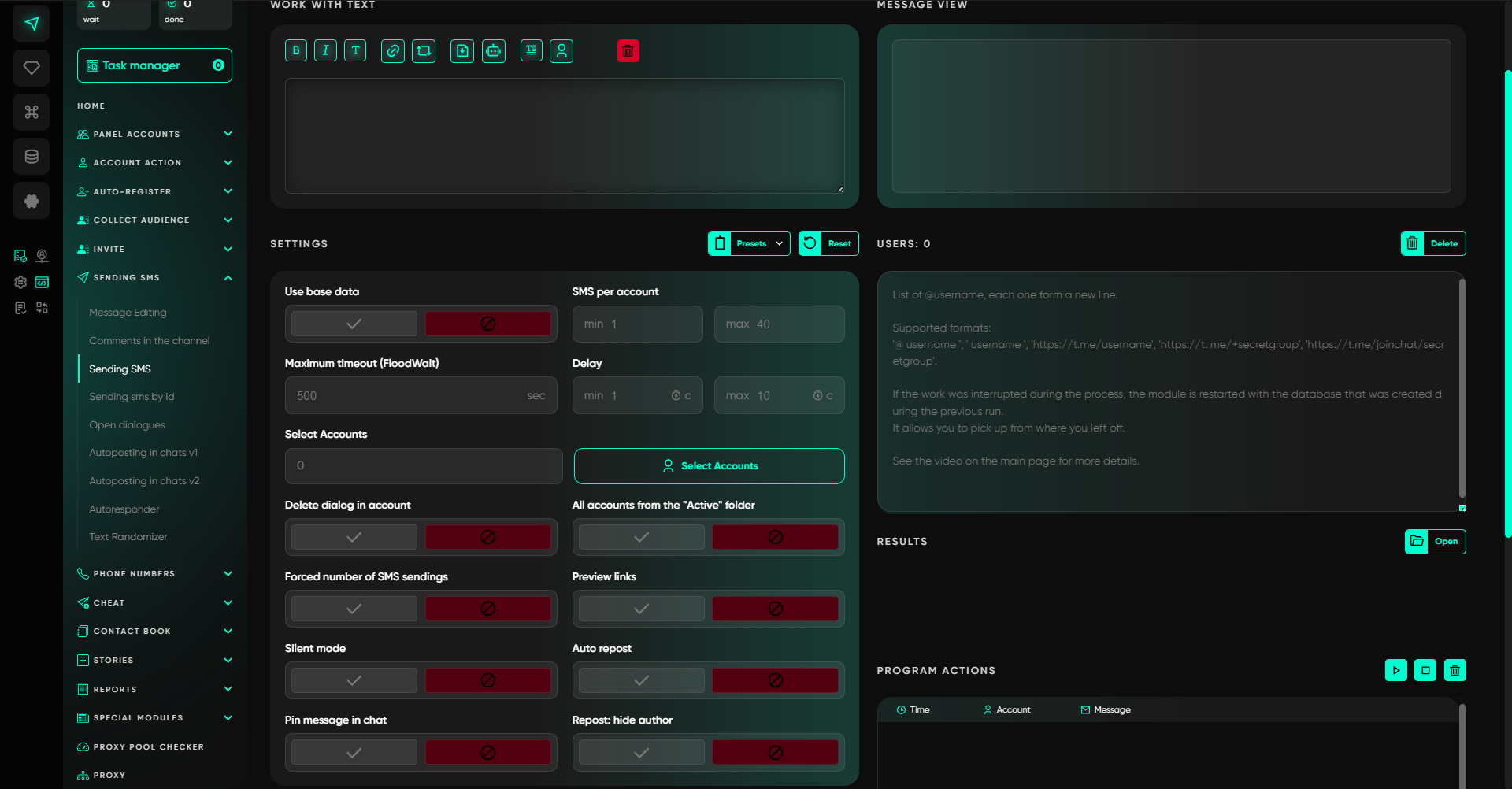
For an A/B test, it is better not to mix random phrase substitution with the experiment itself. Spintax solves a different problem. It selects a text variant while sending, but by itself it does not create two controlled groups, preserve experimental assignment, or determine which version performed better.
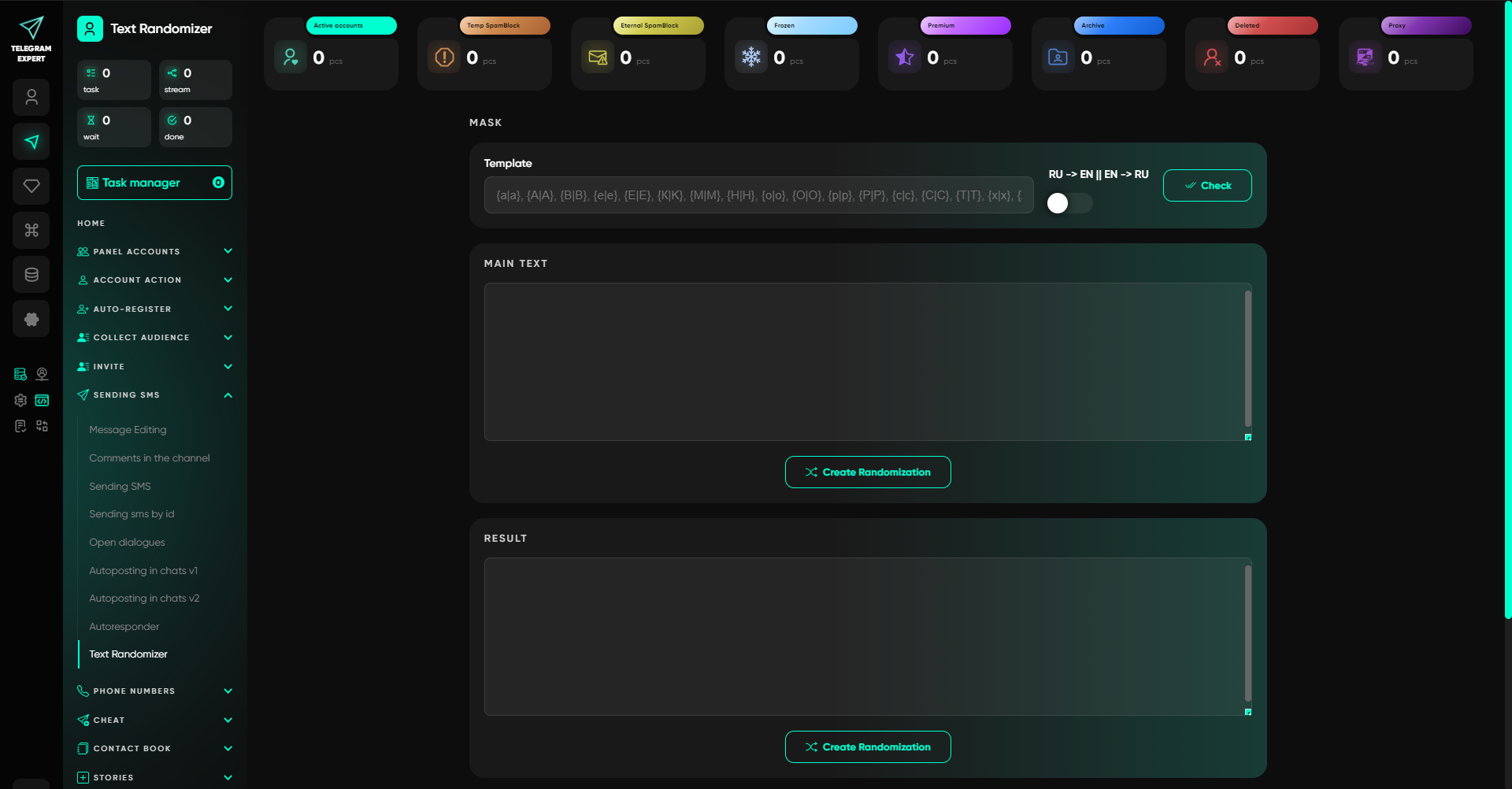
So for the first comparison, prepare fixed A and B messages and record in advance which recipient belongs to each group. In Telegram Expert, the sending itself is then carried out.
Before launch, test both messages on test accounts. Check not only the text, but also the links, attachments, preview, and formatting. The module itself includes a preview of the text portion of the message.
Run the send and do not lose failed operations
After assignment, the task is not simply to send 200 messages with A and 200 with B. You need to preserve the connection between the assigned version and the actual outcome of the operation.
Record:
- who was assigned to A and B;
- which version was assigned;
- whether the message was actually sent;
- which target action the recipient completed;
- which operations ended with an error;
- which test conditions were violated.
This matters because losing part of the observations can distort the result. Microsoft Research describes cases in which a mismatch between the actual group composition and the planned assignment made experimental analysis unreliable.
Telegram Expert includes a “Report Generator.” It creates reports from the bulk-messaging statistics database and stores operation statuses, including successful and failed attempts. With separate filtering, you can retrieve only records with the “Done” status.
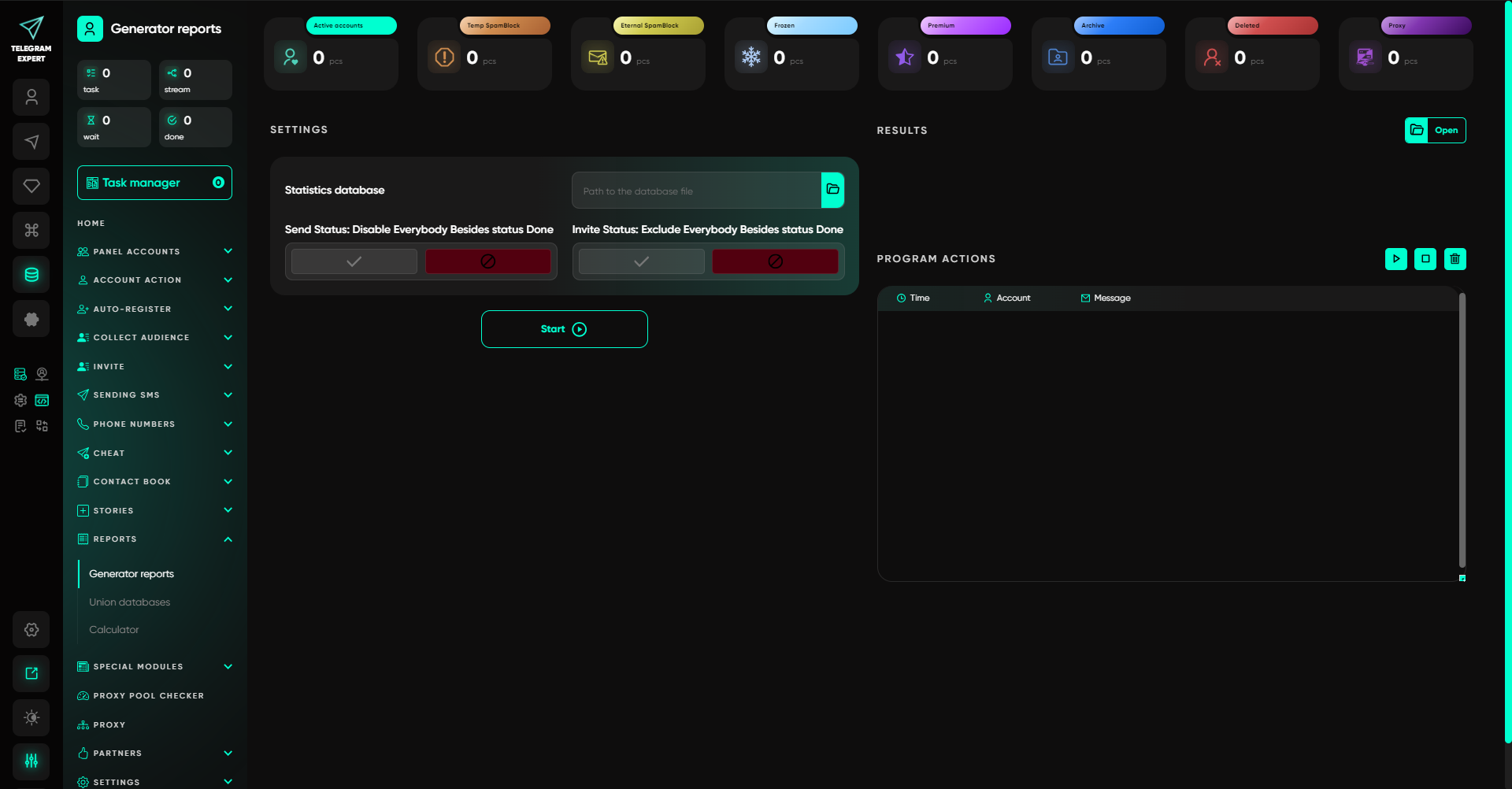
For an A/B test, this means you cannot simply take the list of successful sends and forget about the attempts that failed. Doing so changes the composition of the groups being compared. The operations report is useful for execution control, not for automatically drawing a statistical conclusion about the copy.
Helodata provides the connection infrastructure, not the copy evaluation
If your working setup uses proxies, this part also needs to be brought into comparable conditions before launch.
Helodata provides residential, mobile, and ISP proxies. In Telegram Expert, proxies are added with the address, port, and authentication details, after which they can be checked in a dedicated module.
In this setup, Helodata’s role is limited to connection infrastructure. Proxies do not make two groups comparable and do not determine which copy is more effective. If some sending attempts fail, those failures need to remain in the records and be considered when interpreting the result.
Measure the target action, not just replies
A “reply” may mean agreement, refusal, a follow-up question, or a request not to be contacted again. A single reply count combines very different outcomes.
That is why the primary metric should be defined before launch. For example, if the purpose of the message is to drive event registrations, the target action is a completed registration. Chat replies can be tracked as a secondary metric, but they should not replace the goal selected in advance.
Define the denominator in advance as well. For the primary analysis, you can calculate the share of unique recipients who completed the target action out of everyone assigned to the corresponding group. The rate among successfully sent messages can be shown separately, especially if some operations failed.
Both groups should have the same amount of time to respond. If A is sent in the morning and B in the evening, the end-of-day result gives the groups different observation windows. The appropriate duration depends on the target action itself. There is no universal rule such as “24 hours” or “7 days” that fits every test.
Even if A and B differ, there may be no winner
The number of recipients required for a test cannot be set with one fixed figure. It depends on the baseline target-action rate, the minimum difference you want to detect, statistical power, and the chosen significance threshold. These are the parameters used to calculate sample size.
Do not stop the test as soon as the first convenient result appears. Repeatedly checking interim results increases the risk of reaching a conclusion by chance. For a standard test, define the sample size and stopping rule in advance.
There are four possible outcomes:
Outcome | What to do |
There is convincing and practically meaningful evidence of a difference | Use the selected version under the same conditions and keep monitoring |
There is not enough data | Record the uncertainty and do not declare a winner |
An important metric got worse | Return to the original version and investigate the cause |
The test conditions were violated | Fix the process and run a new test |
Even a confirmed difference does not mean the same effect will hold for every audience. Experimental results depend on the population and conditions in which the test was conducted. Microsoft Research discusses this separately as a question of external validity.
A practical workflow for testing a Telegram message
- Choose one audience and one offer.
- Formulate a hypothesis about the recipient’s response.
- Define the primary target action.
- Save the exact A and B versions.
- Set the test size, observation period, and stopping rule.
- Create non-overlapping groups and preserve each recipient’s assignment.
- Test both messages on test accounts.
- Send both variants under comparable conditions.
- Reconcile group assignments with successful and failed operations.
- Evaluate the target action and record the decision together with its limitations.
Telegram Soft Expert handles the operational side of this workflow: it helps manage databases, select accounts, run bulk messaging, and obtain data on successful and failed operations. Group assignment, assignment tracking, target-action measurement, and statistical inference remain separate parts of the process.
FAQ
Can you compare two completely different messages?
Yes. In that case, the conclusion applies to the entire message version. To test the effect of a specific technique—such as a headline or the order of arguments—you need a separate test.
Can you send both variants to the same people?
For a simple A/B comparison, it is better to use separate groups. If one person receives A and then B, the second outcome depends on the first message. That is a different experimental design.
What if the audience is small?
Do not try to force a precise conclusion about a small difference at any cost. You can separately test whether people understand the message, collect qualitative replies, and use the result as a preliminary observation. Counting the same people again does not create a new independent sample.
Can Telegram Expert spintax be used instead of A and B groups?
Spintax by itself does not replace groups. It randomly selects from predefined phrase variants, but a proper comparison requires controlled assignment, a record of the version actually sent, and separate tracking of the outcome.
Can you compare posts in two different chats?
You can compare the results you receive, but different communities represent different conditions. Such a placement cannot automatically be treated as an independent A/B test.
What if B gets more replies but fewer registrations?
Use the goal you defined before launch. Replies can help explain audience behavior, but they should not replace the primary metric after the result is known.
The main purpose of a test is not necessarily to declare a winner. After the test, the team should have the exact message versions, the conditions in which they were used, execution data, and a clear basis for the next decision. That record is what allows you to improve messages systematically instead of choosing copy based on impressions alone.