IPv4 vs IPv6: What’s the Difference and Which Proxy Should You Choose?
Learn the differences between IPv4 and IPv6, their advantages, and how to choose the right proxy solution. Helodata provides reliable IPv4 and IPv6 proxies for web scraping, automation, and global business operations.

IPv4 and IPv6 are two different Internet Protocol versions used to identify devices online. While IPv4 remains the most widely used protocol due to its compatibility and established infrastructure, IPv6 provides a much larger address pool and improved network efficiency.
For businesses that rely on web scraping, automation, advertising verification, and global online operations, choosing the right IP solution is essential. Helodata provides reliable IPv4 and IPv6 proxy solutions, including residential proxies, mobile proxies, ISP proxies, and datacenter proxies, helping businesses access global data securely and efficiently.
What Is IPv4?
IPv4 (Internet Protocol version 4) is the fourth version of the Internet Protocol and has been the foundation of internet communication for decades.
An IPv4 address consists of 32 bits and is usually displayed in a format like:
192.168.1.1
IPv4 can support approximately 4.3 billion unique IP addresses. However, with the rapid growth of smartphones, IoT devices, and online services, available IPv4 addresses have become increasingly limited.
Despite this limitation, IPv4 is still the dominant protocol worldwide because most websites, networks, and online services continue to support it.
What Is IPv6?
IPv6 (Internet Protocol version 6) was developed to solve the limitations of IPv4 address exhaustion.
Unlike IPv4, IPv6 uses 128-bit addresses, allowing for an almost unlimited number of unique IP addresses.
An IPv6 address looks like:
2001:0db8:85a3:0000:0000:8a2e:0370:7334
The advantages of IPv6 include:
- A significantly larger IP address pool
- Improved network efficiency
- Better support for modern connected devices
- More advanced routing capabilities
- Reduced dependence on NAT (Network Address Translation)
As internet usage continues expanding, IPv6 adoption is becoming increasingly important.
IPv4 vs IPv6: Key Differences
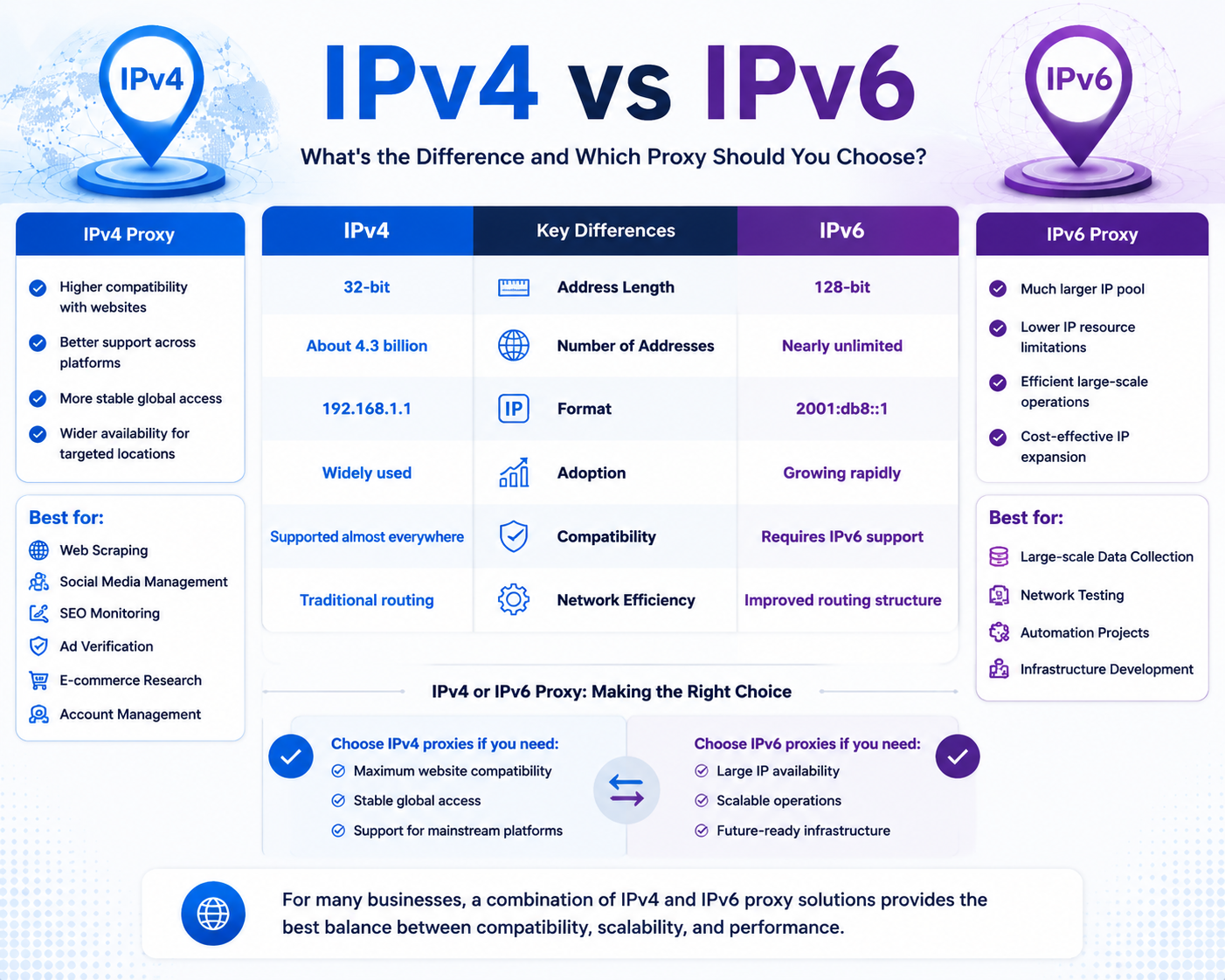
Feature | IPv4 | IPv6 |
|---|---|---|
Address Length | 32-bit | 128-bit |
Number of Addresses | About 4.3 billion | Nearly unlimited |
Format | 192.168.1.1 | 2001:db8::1 |
Adoption | Widely used | Growing rapidly |
Compatibility | Supported almost everywhere | Requires IPv6 support |
Network Efficiency | Traditional routing | Improved routing structure |
IPv4 Proxy vs IPv6 Proxy: Which One Should You Use?
When choosing a proxy solution, the decision between IPv4 and IPv6 depends on your business requirements.
IPv4 Proxy
IPv4 proxies remain the most popular choice because they offer:
- Higher compatibility with websites
- Better support across platforms
- More stable access to global websites
- Wider availability for targeted locations
IPv4 proxies are commonly used for:
- Web scraping
- Social media management
- SEO monitoring
- Ad verification
- E-commerce research
- Account management
For businesses that need maximum compatibility, IPv4 proxies are usually the safer option.
IPv6 Proxy
IPv6 proxies provide advantages for specific use cases:
- A much larger available IP pool
- Lower IP resource limitations
- Efficient large-scale operations
- Cost-effective IP expansion
IPv6 proxies can be useful for:
- Large-scale data collection
- Network testing
- Automation projects
- Infrastructure development
However, some websites and platforms still have limited IPv6 support, so compatibility should always be considered.
How Helodata Helps Businesses Choose the Right Proxy Solution
Different online tasks require different IP resources. Helodata provides multiple proxy solutions designed for various business needs.
Residential Proxy
Helodata residential proxies use real residential IP addresses from global locations, helping users access websites with higher trust levels.
Common applications:
- Market research
- Price monitoring
- Search engine data collection
- Localization testing
Mobile Proxy
Mobile proxies use real mobile network IPs, making them suitable for platforms that require highly trusted connections.
Common applications:
- Social media automation
- Advertising verification
- Mobile app testing
- Multi-account management
ISP Proxy
ISP proxies combine the stability of datacenter infrastructure with the trust of ISP-assigned IP addresses.
They are ideal for:
- Long-term sessions
- Brand monitoring
- Business automation
- Account operations
Datacenter Proxy
Datacenter proxies provide fast and scalable IP resources for high-volume tasks.
They are commonly used for:
- Large-scale scraping
- SEO tools
- Data analysis
- Automated workflows
IPv4 or IPv6 Proxy: Making the Right Choice
There is no single “best” option for every business.
Choose IPv4 proxies if you need:
✅ Maximum website compatibility
✅ Stable global access
✅ Support for mainstream platforms
Choose IPv6 proxies if you need:
✅ Large IP availability
✅ Scalable operations
✅ Future-ready infrastructure
For many businesses, a combination of IPv4 and IPv6 proxy solutions provides the best balance between compatibility, scalability, and performance.
Conclusion
IPv4 continues to power most of today’s internet, while IPv6 represents the future of global connectivity. Understanding the differences between IPv4 and IPv6 helps businesses make better decisions when building online operations.
Whether you need residential proxies, mobile proxies, ISP proxies, or datacenter proxies, Helodata provides reliable IP solutions designed to support global data access, automation, and digital growth.