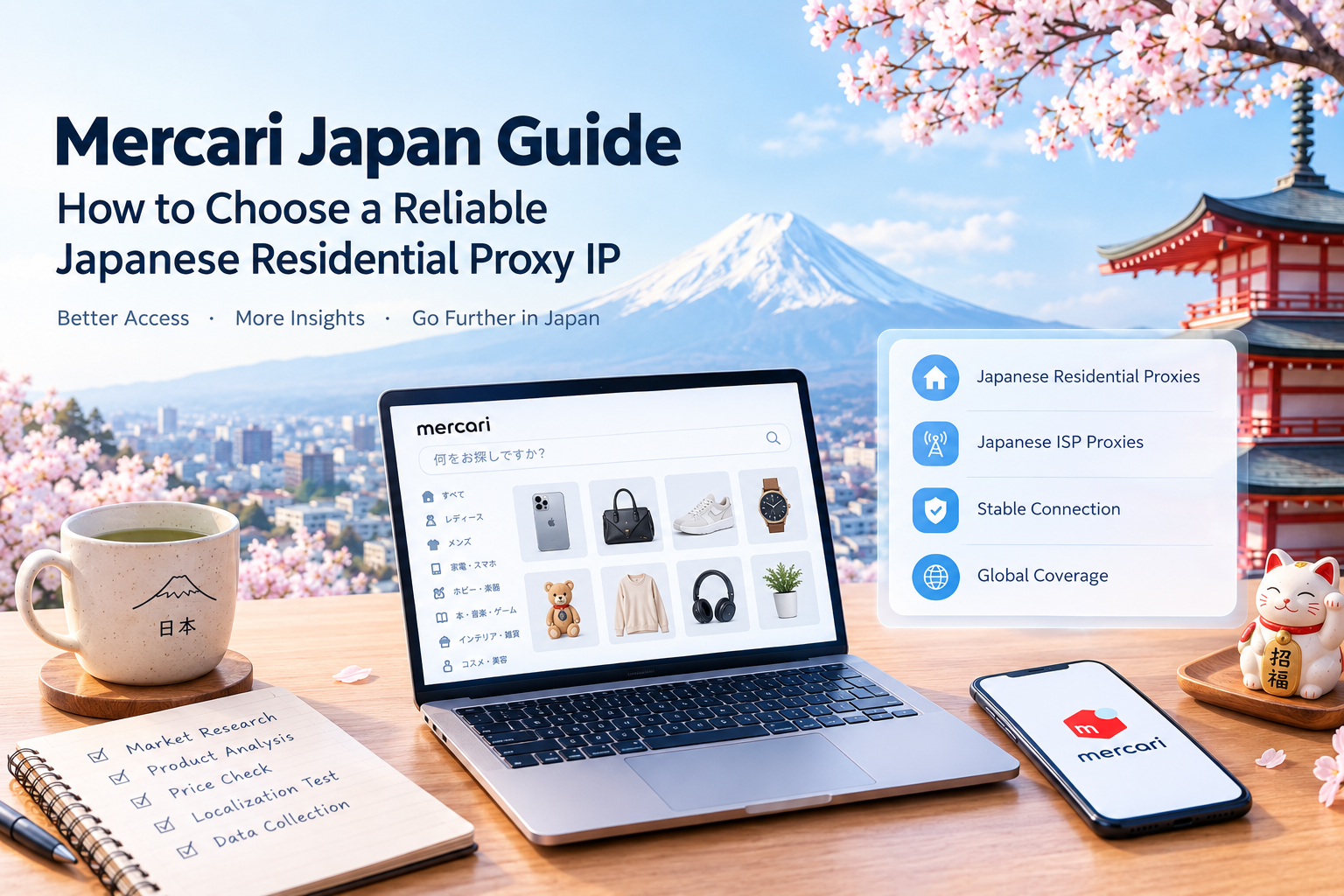
Mercari Japan Guide: How to Choose a Reliable Japanese Residential Proxy IP
Learn how to choose and use Japanese residential and ISP proxies for Mercari, e-commerce research, SEO, and localization testing, and see how Helodata can support Japan-focused network access.

As Japan’s e-commerce market continues to grow, Mercari has become a well-known platform for second-hand products and a valuable source of information for users researching the Japanese market.
For users accessing Mercari and other Japan-focused websites from outside Japan, having a suitable Japanese network environment can be important. Whether you are conducting market research, checking product information, analyzing prices, or testing localized content, the location and type of your IP address can affect the browsing experience.
This is one reason why Japanese residential proxies have become increasingly useful for businesses and individuals working with Japan-focused online activities.
In this guide, we’ll explore Japanese residential and ISP proxies, explain what to consider when choosing a Japanese proxy, and show how Helodata can support Japan-focused network access and localization testing.
Why Does Your IP Matter When Accessing Mercari Japan?
When you visit a website, the site can generally identify the IP address associated with your connection. This IP can provide information about the approximate country or region from which the request originates.
For example:
- A US IP indicates a US network environment
- A UK IP indicates a UK network environment
- A Japanese IP indicates a Japanese network environment
If your business focuses on the Japanese market, using a Japanese IP can provide a network environment that is more closely aligned with the target market.
This can be useful for activities such as:
- Japanese e-commerce market research
- Mercari product and price research
- Localized SERP analysis
- Website localization testing
- Japan-specific content verification
- E-commerce page testing
- Public web data collection
However, an IP address is only one part of the overall environment. Websites may also consider account information, browser settings, access behavior, and their own security policies.
Therefore, a Japanese IP should not be viewed as a way to bypass platform restrictions.
Why Use a Japanese Residential Proxy?
There are several types of proxy IPs available today, including datacenter proxies, residential proxies, and ISP proxies.
For Japan-focused localization and browsing scenarios, residential proxies are one option worth considering.
1. A Network Environment Closer to Residential Users
Residential proxies are associated with residential network environments.
Compared with datacenter IPs, residential IPs generally have network characteristics that are closer to those of regular household users. This makes them suitable for applications that require localized access and network environment testing.
For example, if you need to check Japanese search results, test Japanese websites, or conduct Japanese e-commerce research, a Japanese residential proxy can provide a Japanese network exit point.
2. Suitable for Localized Business Activities
When testing different markets, simply using a generic overseas IP may not provide the environment you need.
For example:
China market → China IP
US market → US IP
Japan market → Japan IP
Choosing a proxy based on your target market can make localization testing more relevant to the region you are researching.
3. Useful for Ongoing Network Requirements
For businesses that regularly conduct market research or website testing, network consistency can be more useful than simply having access to a large number of IPs.
When evaluating a proxy provider, consider factors such as IP stability, geographic coverage, and network type instead of focusing only on the total number of available IPs.
Japanese Residential Proxy vs. Japanese ISP Proxy
When looking for Japanese proxies, you may come across both residential proxies and ISP proxies.
Although both can provide Japanese network access, they have different network characteristics.
Japanese Residential Proxies
Residential proxies focus primarily on residential network characteristics and can be useful for:
- Localized browsing
- E-commerce research
- Website testing
- Search result verification
- Data collection
If your main requirement is access through a Japanese residential network, a residential proxy can be a suitable option.
Japanese ISP Proxies
ISP proxies place more emphasis on ISP-related network characteristics.
They may be useful when a specific Japanese ISP network environment is required or when you need to test IPs associated with different network providers.
The right choice ultimately depends on your specific requirements.
Before choosing a proxy, consider:
Which location do you need?
Which network type is appropriate?
Do you need a stable connection?
Do you need to verify ISP and ASN information?
Answering these questions first can make it easier to select the appropriate proxy type.
How to Choose a Japanese IP for Mercari?
If your main goal is to access Mercari Japan or conduct Japanese e-commerce research, there are several factors worth considering.
1. IP Location
First, verify that the IP is actually located in Japan.
If your business requires more specific localization testing, you can also check the city or region associated with the IP.
For example:
- Tokyo
- Osaka
- Nagoya
- Fukuoka
Different regions may have different network characteristics, so your choice should depend on the requirements of your specific project.
2. IP Type
Don't look only at whether an IP is labeled as “Japan.”
You should also consider whether it is:
- Residential
- ISP
- Datacenter
Different IP types are designed for different use cases.
If your goal is to access a network environment that is closer to regular residential users, Japanese residential proxies may be worth considering.
3. ISP and ASN
If your requirements are more specific, you can also check the ISP and ASN associated with the IP.
IP lookup tools can typically provide information such as:
- IP Address
- Country
- City
- ISP
- ASN
- Proxy Detection
This information can help you determine whether the IP matches your expectations.
For example, if you selected a Japanese IP but the lookup results show an unexpected country, city, or network provider, you may need to check the proxy configuration or the IP itself.
4. IP Stability
For ongoing projects, stability is another important factor.
An IP connection that frequently disconnects or changes unexpectedly can make everyday operations and testing more complicated.
When choosing a Japanese proxy, consider the overall reliability of the connection rather than focusing solely on the number of available IPs.
How to Use Helodata Japanese Residential Proxies
Helodata provides residential proxy IPs for various geographic access, localization testing, and market research scenarios.
If you need a Japanese IP, the basic workflow is straightforward.
Step 1: Choose a Japanese Proxy
Select a Japanese residential proxy based on your actual business requirements.
If you are conducting general website access, localization testing, or market research, you can start by testing a Japanese residential IP.
Step 2: Configure the Proxy
After obtaining your proxy information, configure it in your browser or the environment you use for your business activities.
The exact setup process depends on the browser, application, or tool you are using.
Once configured, it is recommended to test the connection before starting your main activities.
Step 3: Check the IP Information
After connecting through a Helodata proxy, use an IP lookup or detection tool to verify the network information.
Pay attention to:
Country: Japan
City: Target location
ISP: Actual network provider
ASN: Network ownership
Proxy Detection: How the IP is classified by the detection service
This helps confirm whether the proxy matches your requirements.
Step 4: Start Testing
Once the IP information has been verified, you can begin your intended activities.
For example:
- Mercari page testing
- Japanese product research
- Japanese market price research
- Japanese SERP analysis
- Japanese website testing
- Localized content verification
For projects that require a more consistent network environment, you can choose an IP usage strategy based on your specific requirements.
Why Is IP Detection Important?
Many users focus on one simple question when choosing a proxy:
“Is this a Japanese IP?”
However, that alone does not provide the complete picture.
An IP detection tool can provide additional information about the network.
Country
Confirms whether the IP is associated with the target country.
City
Shows the approximate city or region associated with the IP.
ISP
Identifies the network service provider associated with the IP.
ASN
Provides additional information about the network's ownership or routing organization.
Proxy Detection
Shows whether the IP is identified as a proxy, VPN, or another type of network connection by the detection service.
For this reason, checking an IP before using it can be a simple but useful step when setting up a localized network environment.
What Businesses Can Use Helodata Japanese Proxies For
Japanese proxies are not limited to Mercari.
If your business involves the Japanese market, Helodata residential proxies can also support various use cases.
Japanese Market Research
Access target websites through Japanese IPs to research local market information.
E-commerce Research
Research products, pricing, and page content on Japanese e-commerce websites.
SEO
Check localized search results and website content from a Japanese network environment.
Website Testing
Test how websites appear and perform when accessed from Japan.
Data Collection
For publicly available web data and in accordance with applicable website rules and laws, proxies can be used to support research and data collection workflows.
Localization Verification
Check whether websites display the appropriate content based on the visitor's geographic location.
What Should You Consider When Using Japanese Proxies?
A proxy can provide a different network exit point, but it does not solve every aspect of an online workflow.
When working with Mercari or other e-commerce platforms, consider the following points.
Don't Treat Proxies as a Way to Bypass Platform Rules
The primary purpose of a proxy is to provide a network connection and geographic access.
It does not replace identity verification and should not be used to circumvent platform policies.
Avoid Unnecessary IP Switching
If your workflow does not require frequent IP changes, constantly switching network environments may create additional management complexity.
For long-term projects, a stable and controllable network environment can be easier to manage.
Test Before Starting
Before using a proxy for a larger project, test:
- IP location
- ISP
- ASN
- Connection stability
- Actual website accessibility
Once the results meet your requirements, you can proceed with your intended workflow.
How to Choose the Right Helodata Proxy
Different businesses have different proxy requirements.
If your primary requirement is:
Japanese localized access
A Japanese residential proxy may be a suitable starting point.
If your business:
Requires a specific ISP network environment
You may want to consider Japanese ISP IPs.
If your business:
Requires website testing across multiple countries
You can select residential proxies based on your target markets.
Helodata provides global IP proxy resources, allowing users to select network access based on their specific business requirements.
For users who are new to proxies, it is generally better to start with the actual requirements of the project and test the connection before choosing a larger proxy setup.
Conclusion
For Mercari Japan and other Japan-focused business activities, a suitable Japanese network environment can provide better conditions for localized browsing, market research, SEO analysis, and website testing.
When selecting a Japanese proxy, don't focus only on whether the IP is located in Japan.
IP type, location, ISP, ASN, stability, and actual accessibility should all be considered.
Helodata's residential proxies provide IP resources for users who need Japanese network access, supporting use cases such as Japanese market research, e-commerce research, website testing, and localization verification.
A practical workflow is:
Define your requirements → Select the right Japanese IP → Check the IP information → Test the connection → Establish a stable network environment.
For businesses working with the Japanese market, a suitable and reliable IP can be more valuable than simply having access to a large number of IPs.