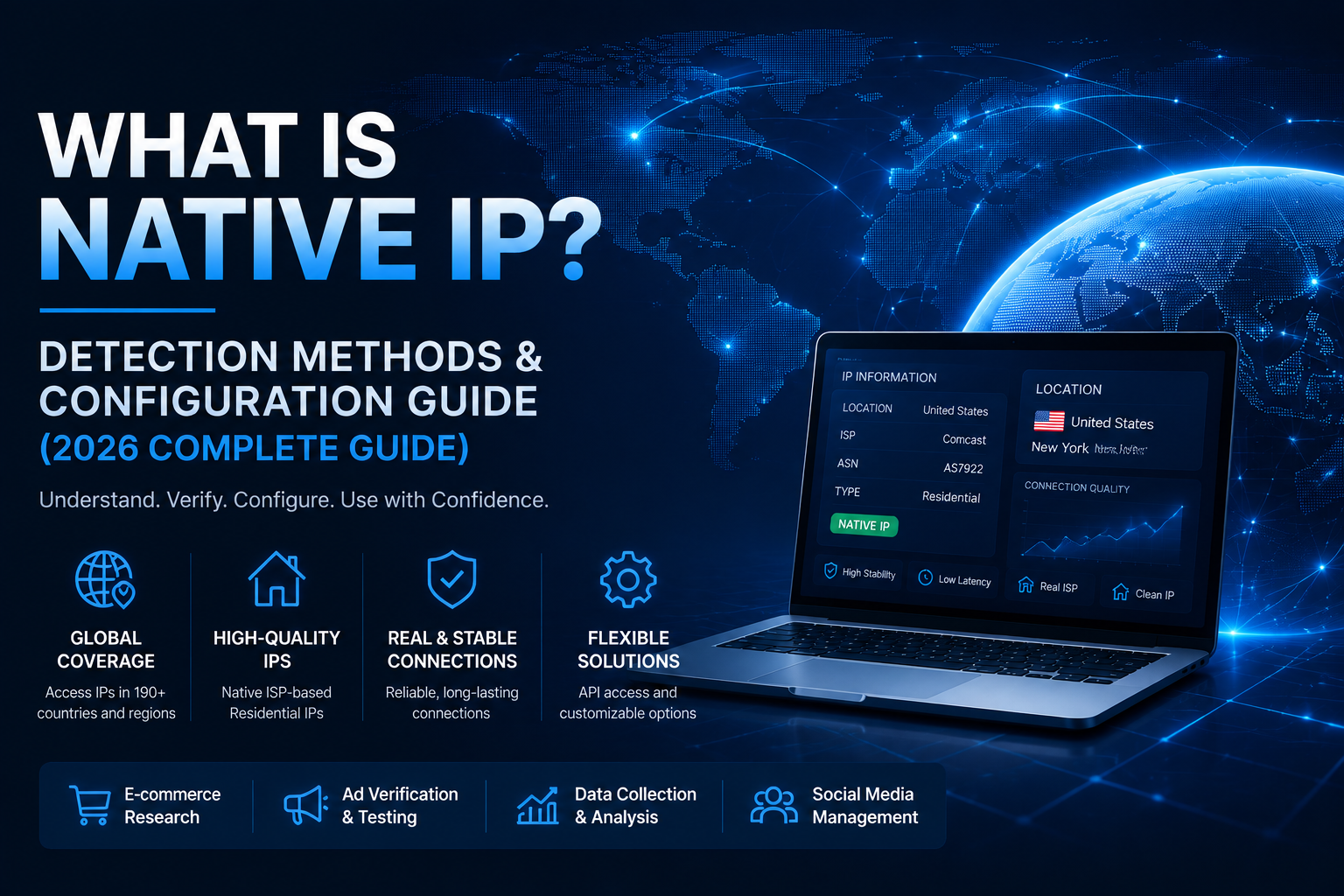
Native IP Explained: What Is a Native IP? How to Identify, Choose, and Configure It Correctly
Native IPs are IP addresses assigned by local ISPs in specific regions, providing more accurate geographic network characteristics. This guide explains what Native IPs are, how to identify them, the differences between Native IPs and other proxy types, and how Helodata helps businesses choose suitable IP solutions for global operations.

In today’s rapidly developing global digital economy, an IP address is no longer just a network identifier for a device. For businesses involved in cross-border e-commerce, advertising, data analysis, social media operations, and regional testing, having an IP environment that matches the target location can significantly improve the accuracy and efficiency of online operations.
In the proxy industry, Native IP has become an increasingly discussed concept.
So, what exactly is a Native IP? How is it different from regular proxy IPs? How can you determine whether an IP is truly native? And how should it be configured correctly?
This guide will explain the definition of Native IPs, identification methods, practical applications, and configuration steps.
What Is a Native IP?
A Native IP generally refers to an IP address that is directly assigned by a local Internet Service Provider (ISP) in a specific country or region and belongs to the local network environment.
In simple terms:
If a user wants to access the US market, an IP address provided by a local US network operator can be considered to have native US network characteristics.
Examples include:
- IPs assigned by US ISPs such as Comcast and AT&T
- IPs provided by Japanese network operators such as NTT and KDDI
- IPs belonging to local European providers
These IP addresses usually have stronger geographic relevance because their network ownership and location are closely connected to the target region.
In comparison, some non-native IPs may appear to be located in a certain country, while their actual source may come from:
- Data center servers
- Cloud infrastructure providers
- Secondary proxy networks
- IP registrations that do not match the actual network location
Therefore, for businesses that require accurate regional network environments, Native IPs can provide more reliable geographic characteristics.
Native IP vs Regular Proxy IP: Key Differences
Many users often confuse different types of IP resources, including:
- Native IP
- Residential IP
- Datacenter IP
- ISP IP
Although they are related, they have different characteristics.
Type | Source | Main Characteristics |
|---|---|---|
Native IP | Local ISP network | Accurate geographic network attribution |
Residential IP | Home user networks | Closer to normal user connections |
Datacenter IP | IDC / cloud servers | Fast speed and large-scale availability |
ISP IP | ISP-registered server IP | Higher stability and consistency |
It is important to understand:
Not every residential IP is a Native IP, and an IP located in a specific country is not automatically a Native IP.
The key factors include:
- IP registration information
- ASN information
- ISP ownership
- Network routing details
Why Are Native IPs Important?
As businesses expand globally, more applications require accurate regional network environments.
Native IPs are commonly used in several scenarios.
1. Cross-Border E-commerce Market Research
Users in different countries may see different:
- Product prices
- Search results
- Recommendations
- Website languages
Using IPs that match the target market allows businesses to better understand local online environments.
Common applications include:
- Competitor price monitoring
- Product page analysis
- Market trend research
2. Advertising Verification and Testing
Global advertising campaigns may display different content depending on location.
Marketing teams can use regional IP environments to:
- Check advertisement displays
- Analyze regional differences
- Optimize advertising strategies
3. Data Collection and Market Analysis
Businesses often need to access publicly available online information from different regions.
High-quality IP environments can support:
- Regional data collection
- Market monitoring
- Data modeling
- Industry research
4. Social Media Operations
Global brands often manage social media activities across multiple markets.
Platforms may include:
- TikTok
- X (Twitter)
Different network environments can affect how content and services are displayed in different regions.
How to Determine Whether an IP Is a Native IP?
Determining whether an IP truly belongs to a specific region requires more than simply checking its displayed location.
Several methods can be used.
Method 1: Check IP Geographic Information
The most basic approach is to review:
- Country
- City
- ISP
- ASN
For example:
Country: United States
ISP: Local network provider
This usually indicates stronger geographic relevance.
However, geographic location alone is not enough to fully verify an IP source.
Method 2: Check ASN Information
ASN (Autonomous System Number) represents the network organization responsible for an IP range.
For example:
Local residential providers usually operate their own ASN networks.
If a US IP is registered under a large cloud hosting provider, it is more likely to belong to a data center environment rather than a local user network.
Method 3: Review IP Intelligence Databases
Professional IP databases usually provide information such as:
- Hosting Provider
- ISP
- Residential classification
- Business classification
- Mobile network information
Using multiple data sources together can improve IP classification accuracy.
Method 4: Analyze Network Characteristics
Besides IP ownership information, network performance can also provide useful insights.
Important factors include:
- Latency
- Routing path
- Connection stability
Different IP sources often show different network behaviors.
How Helodata Helps Users Access High-Quality IP Environments
For businesses that require global network access, IP quality plays an important role.
Helodata provides global proxy IP solutions, helping users select suitable network environments based on their business requirements.
With Helodata, users can access flexible IP resources for different scenarios.
Global Geographic Coverage
Helodata supports IP resources from multiple regions, helping users with:
- International market research
- Global data analysis
- Regional testing
Flexible Proxy Type Options
Different business scenarios require different proxy solutions.
Users can choose from options such as:
- Residential proxies
- Mobile proxies
- ISP proxies
- Datacenter proxies
These options allow businesses to balance speed, stability, and geographic requirements.
API and Batch Management Support
For enterprise users and development teams, Helodata supports flexible integration methods.
Businesses can use proxy resources for:
- Automated workflows
- Large-scale operations
- Programmatic access
Helping improve overall operational efficiency.
How to Configure a Native IP Proxy
The configuration process is generally simple.
Step 1: Obtain Proxy Information
A proxy service usually provides:
- Proxy Host
- Port
- Username
- Password
Example:
Host: proxy.example.com
Port: 8000
Username: your_username
Password: your_password
Step 2: Configure Your Browser or Software
Common supported environments include:
- Chrome
- Firefox
- Fingerprint browsers
- Data collection tools
- Automation software
Enter the proxy information:
Proxy address:
proxy.example.com
Port:
8000
Then complete username and password authentication.
Step 3: Verify the Connection
After configuration, users can check:
- Current IP address
- Country and region
- ISP information
- ASN details
This helps confirm whether the connection matches the target requirements.
What Should You Consider When Choosing a Native IP Service?
1. Do Not Focus Only on IP Quantity
A large number of IPs does not always mean better quality.
More important factors include:
- IP source
- Stability
- Geographic coverage
- Network performance
2. Choose Based on Your Business Needs
Different scenarios require different IP types.
Use Case | Recommended IP Type |
|---|---|
Data analysis | Residential / ISP Proxy |
E-commerce research | Native Residential IP |
Advertising verification | Target-region IP |
Enterprise access | Stable ISP IP |
3. Test Before Long-Term Deployment
Before using a solution at scale, it is recommended to:
- Test IP quality
- Verify geographic accuracy
- Monitor connection stability
Choosing the right solution based on actual requirements can improve long-term performance.
Conclusion
The core value of Native IPs lies in their authentic regional network characteristics.
As global business continues to expand, accurate and reliable network environments have become increasingly important. From cross-border e-commerce and advertising verification to data analysis and market research, high-quality IP resources have become an essential part of modern digital operations.
When selecting a proxy solution, businesses should consider more than just IP quantity. Factors such as IP source, geographic coverage, stability, and service capabilities are equally important.
With Helodata’s global proxy solutions, users can select suitable IP resources based on their specific requirements and build more flexible and efficient global network access environments.